

Situated
at the crossroads between East and West, Dubai occupies a
naturally-strategic location on the world aviation map. Developments in
airport services have been swift, with Dubai progressing from sand-strip
aerodrome to world-class aviation hub in just six decades.
The UK's Royal Air Force and Imperial Airways,
forerunner of today's British Airways, flew across the Gulf region from as
early as 1929, but it was not until 1937 that a proper service began to
use Dubai as a permanent port of call.
In 1934, Imperial Airways had been awarded the contract
to fly the postal route to Australia, a route which necessitated a
stopover somewhere in the Gulf. Previously, Sharjah, the emirate to the
immediate north of Dubai, had been used as a 'land' stopover point for
east-bound journeys, but the new postal service was to use Shorts flying
boats and, as such, Sharjah was no longer viable.
Dubai, and another neighbouring emirate, Umm Al Quwain,
were both options, but Dubai was selected because its creek was considered
to be a better landing 'ground'. In July 1937, the then Ruler of Dubai,
Sheikh Saeed bin Rashid Al Maktoum, signed an agreement allowing Imperial
Airways the use of 1,800 yards of Dubai Creek near the spot where Al
Maktoum bridge now stands, plus the right to install refuelling
facilities, on a one-year contract for the modest rent of 440 rupees a
month. The following year, Sheikh Saeed realized how valuable the creek
would become and raised the rent to 940 rupees a month, with a five-rupee
landing fee for every aircraft.
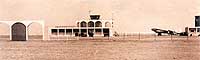
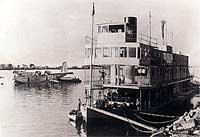
By the end of World War II, the service - now run by Imperial Airways' successor, British Overseas Airways Corporation - had grown to four regular weekly passenger and mail trips. This situation continued to grow until 1959, when Dubai's foresighted Ruler, HH the late Sheikh Rashid bin Saeed Al Maktoum, revealed plans for a new civil airport, to be located two-and-a-half miles from the center of Dubai.
Opened in 1960, the new airport initially had a 6,000-foot dirt runway capable of handling Dakota and Heron aircraft - the most popular airlines in use at the time. But the dirt runway was soon topped off with a hard surface, and in 1965 the airport welcomed its first jet airliner, a de Havilland Comet.
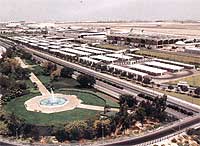
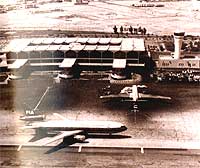
Still located on the original site, Dubai International Airport has changed out of all recognition since 1960. In 1971, an elegant terminal building, designed by architects Page and Broughton, was constructed some distance to the east of the original terminal.
Described by Alexander Frater in his book beyond the Blue Horizon as small and extravagantly pretty, built around rows of slender columns with their tops spreading like date palms', this new terminal was further doubled in size in the 1980s with the addition of a new arrivals building. By this time, the airport had two concrete runways, each 13,200 feet long and capable of handling aircraft that were becoming bigger and bigger in size.
During the late 1960s, 1970s and 1980s, air traffic increased dramatically, reflecting not only the rapid development of Dubai itself, but the fact that the area was still an essential stopping place for large numbers of aircraft flying between Europe and the Far East. In 1967, the airport handled 81,473 passengers; just a year later, the figure was 135,299.
Working closely with both the Dubai Government and the Dubai Department of Civil Aviation, execution of the expansion program has been undertaken by International Bechtel, the US-based construction and engineering management company which has acted as a consultant to the DCA through all stages of the airport's development since 1978.
As the 'boom' continued and more aircraft started to serve Dubai, so figures continued to increase dramatically, to 1980 total of 2.8 million passengers carried by 35 airlines. By the mid-1990s, the equivalent figures were six million passengers and more than 60 airlines, linking Dubai with an ever-expanding network of destinations around the world.
Passenger numbers continued to grow and by 1998 the airport was being served by more than 80 airlines carrying more than seven million passengers. By this time, the Dubai Government had announced a massive and visionary expansion program that would take the airport into the 21st century - and as the new century now gets under way, so the plan has become reality.
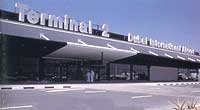
The
first phase of the US$540 million expansion program at Dubai International
Airport was completed in 1998, with the opening of Terminal 2. It was
principally designed for charter flights, executive flight services and
Haj flights - transporting Muslim pilgrims to the Holy sites in Saudi
Arabia - but today is a major terminal in its own right and also handles
scheduled flights.
Located to the north of Terminal 1, the 12,000 square
meter Terminal 2 has a maximum capacity of 1,000 departing passengers and
500 arriving passengers per hour, and currently handles 2.5 million
passengers a year.
For passengers arriving by car, the terminal provides
ample free parking space; and for passengers connecting to or from flights
serving Terminal 1, the land transfer time between terminals is less than
10 minutes.
Terminal 2 is located close to a burgeoning free zone,
which is attracting investment from blue-chip companies around the world -
and with it, an increasing number of visiting business executives using
private jets.
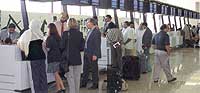
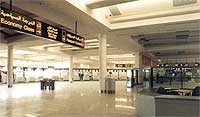
In addition to 22 check-in counters and five boarding
gates, Terminal 2 is fully equipped with information desks, car hire
counters, foreign exchanges and all the facilities required by those
on the move.
VIP passengers have their own entry and exit area as
well as exclusive executive lounges which
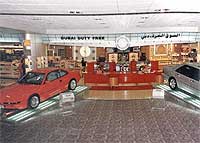
The bright and spacious terminal has a 1,200 square-meter area devoted to duty-free shopping. Prestige brands are available at very competitive prices and the complex is operated to the same high standards which have already won Dubai Duty Free a host of international awards. The wide product range displayed in also backed up by a bulk purchase desk.
Passengers using Terminal 2 may also participate in the various promotions organized by Dubai Duty Free, including the popular Millennium Millionaire and Finest Surprise draws, which offer passengers the chance to walk away with a million dollars and a luxury limousine, respectively.

EGYPT - SYRIA - JORDAN