

Celebrating is fifteenth anniversary in 2000, Emirates, the international
airline of the UAE, continues to set new standards and win more
international awards. Few airlines can claim to provide such consistently
high levels of customer service for First Class, Business Class and
Economy Class passengers.
Since its launch in 1985, Emirates has played a major
role in Dubai International Airport's development as one of the fastest
growing aviation hubs in the world. Dubai is its home base, and the
airline is by far the airport's biggest single customer, carrying
ever-increasing numbers of business and leisure travelers.
In the next two years, Emirates aims to become a global
carrier, serving all six continents. The airline has recently introduced a
new corporate livery to coincide with an ambitious fleet expansion and
renewal program, and to reflect the airline's commitment to the highest
standards of quality and excellence.
As of mid-2000, Emirates was serving 51 destinations in
the Middle East, Europe, Africa, the Asian subcontinent, South-East Asia
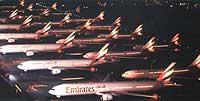
and Australia, with a fleet of 32 aircraft - nine Airbus A330-200s; eight
Airbus A310-300s; four Airbus A300-600Rs; nine Boeing 777-200s and two
Boeing 777-300s.
This fleet will be upgraded in 2003 with the delivery
of nine more A330-200s, which will replace the existing A310-300s and
A300-200s, which will replace the existing A310-300s and A300-600Rs, while
a third Boeing 777-300 will be delivered at the end of 2000 and a fourth
in March 2001. Thereafter, between 2002 and 2003, when it takes delivery
of six long-range A340-500s, Emirates will be able to
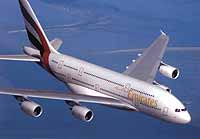
Emirates has also announced its decision to become a launch customer for the A3XX which will carry more than 500 passengers over a non-stop range of 12,800 kilometers. Emirates is looking at five firm orders and five options, including two freighters.
Since late 1999, Emirates has introduced six new destination to its network. In November 1999, the airline began operating six flights a week between Dubai and Munich, and added a seventh flight from January 2000. In November, it also began a twice-weekly service between Dubai and Stockholm in a codeshare agreement with Srilankan Airlines, increasing the frequency to three flights a week from December.
In January 2000, Emirates began six flights a week between Dubai and Bahrain, increasing the frequency to two flights daily from March; March also saw the launch of three flights a week between Dubai and Entebbe in Uganda, and four flights a week between Dubai and Sydney, via Singapore. In April, Emirates began flying three times a week between Dubai and Milan, with outbound flights via Rome and inbound flights direct from Milan to Dubai.
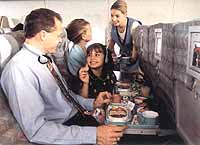
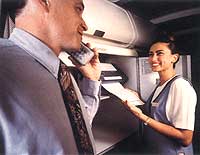
Since its inauguration in 1985, Emirates has continued to introduce innovative facilities for its passengers, with a number of world 'firsts' for any airline. In 1992, it became the first airline to install personal video systems in all seats in all classes throughout its fleet, and in 1995 became the first airline in the world to equip its entire fleet with in-flight telephones and fax machines.
The airline's Boeing 777s arrived in 1996, containing such new features as 17 movie and television channels, 22 audio channels and two external cameras to beam live images of take-off, landing and en-route scenery directly to the cabin's main screen and every seat monitor. The Airbus A330-200 joined the fleet in 1999 and Emirates then became the first airline in the world to feature video cassette players in both First Class and Business Class, offering passengers a wide choice of the latest movie releases.
In the same year, Emirates became the first airline to install new Scima seats in First Class cabins in the Airbus A330-200. The seats feature a unique, electrically-operated privacy hood. All seats in Boeing 777s and Airbus 330-200s are fitted with telephone handsets, allowing passengers to make credit card phone calls from their seats. Wall-mounted telephones are available in all cabins on board Airbus A310-30s and A300-600s, while every aircraft in the fleet has a centralized fax machine.
International airline passengers obviously appreciate the facilities provided on board Emirates' flights. The airline has won more than 190 international awards, not only from industry organizations, but from surveys involving the traveling public. Most significantly, Emirates was voted OAG Worldwide' Airline of the Year' in 1994, 1998, 1999 and 2000.
Emirates plays a vital role in helping to raise Dubai's profile as a leading business and leisure destination - not only through its world-class services across an ever-growing network, but also through its sponsorship of international sporting events which are watched by millions of people around the globe. These include the US$6 million Dubia World Cup, the richest horse race in the world, which has been sponsored by Emirates since its first running in 1996; the Dubai Rugby Sevens, for which Emirates is also the title sponsor; and the Dubai Shopping Festival, an annual month-long event which attracts nearly two million people to Dubai and for which Emirates is a major sponsor.
Emirates Leisure Division
Emirates' Destination and Leisure Management Division comprises Emirates Holidays, the wholesale tour operator; Arabian Adventures, the destination management company, and Al Maha Desert Resort, the region's first luxurious eco-tourism project.
Emirates Holidays, the largest wholesale tour operator in the Gulf and Middle East, offers more than 1,000 vacation products to more than 30 destinations. With a new series of brochures launched in April 2000 under the title A World of Choice, Emirates Holidays' products are now available through travel retailers in 22 countries across the world.
Arabian Adventures is instrumental in the tourism product development of Dubai and the UAE and works together with the Dubai Department of Tourism and Commerce Marketing to promote Dubai to the world. Arabian Adventures designs, operates and conducts a full range of tours, desert safaris, overland tours and incentive programs - all of which attract visitors from around the world.
Al Maha Desert Resort is a 30-suite property owned and managed by the Emirates Group, set in a 25-square-kilometer nature reserve to which indigenous plant and animal species have been reintroduced, including the fabled Arabian Oryx.
Emirates SkyCargo
The airline's award-winning air freight division has been named 'Cargo Airline of the Year' 1994/95 and 1998/99, plus 'Best Airline to the Middle East' for 11 years running, by the UK publication Air Cargo News.
Emirates SkyCargo utilizes available hold space in the airline's passenger fleet, and also operates a leased Boeing 747 freighter on routes including Dubai-Amsterdam (making the Dutch cit a cargo-only destination).
In May 1999, Emirates SkyCargo launched a state-of-the-art automation system branded SkyChain to enable the airline to manage a much wider range of processes in the cargo supply chain. Emirates was also the first air cargo operator in the world to allow customers to track consignments on the Internet.

EGYPT - SYRIA - JORDAN