

But once in the town itself, there is a bustle of activity everywhere!
A multitude of passages, stairways and small courtyards lead into a maze of streets lined with stalls selling silver jewellery, copper trays, pottery painted in Fez blue, multicoloured djellabas, honey cakes, lamb kebabs, grilled almonds and mint tea.
There is profusion in all things. Even in Fez itself, with its multiple facets. For apart from the European town with its broad avenues built after the First World War, there is also Fez el Jedid and Fez el Bali.
In Fez el Bali there are also two distinctly different districts. During the VIIIth century, 8,000 Arab families settled on the right bank of Wadi Fez, after having been expelled from Andalusia by the Christian armies. One hundred years later, 2,000 Kerouan families established their homes on the opposite bank.
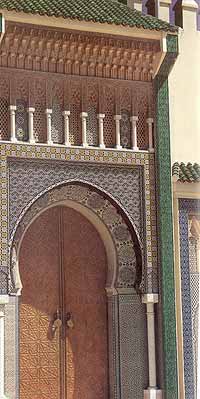
The Andalousian arabs brought with them their art and the experience of a civilisation at the very peak of its glory - as demonstrated by the splendid decorations, stucco and mosaic in the Andalousian mosque and the Es-Sahrij medersa (Koranic school).
The Kerouan heritage includes the imposingly rich Qaraouiyyin, the first university in the western world and still today one of the main intellectual centres of North Africa.
When the Merinides came to power in the XIIIth century, they found Fez el Bali too small to contain the palaces that would be worthy of their magnificence. So they built them outside the city walls, adding gardens, mosques, Koranic schools and souks. Which is how New Fez, or fez el Jedid, was born.
The first capital of the realm in 809 under Idriss II, and then twice again, in the XIIIth century under the Merinides and in the XIXth century under the reign of Moulay Abdallah, Fez is the spiritual and cultural centre of traditional Morocco - and the most imperial of all the imperial cities.

EGYPT - LEBANON - SYRIA