

The mightiest kings fought for it, a line of dynasties inherited it sages, craftsmen, architects, painters and sculptors of all ages built magnificent palaces, mosques, gardens and Koranic schools.
Marrakesh, the imperial city which, at the dawn of its history, gave Morocco its name.
The Berbers and the Arabs come together here, to mingle with the nomads and the mountain people. Every imaginable commodity abounds, craftsmanship flourishes, and there are palaces, hotels, restaurants, golf courses and a casino: Marrakesh is the unchallenged capital of Southern Morocco.
For all the beauty gathered here in one thousand years, for the sheer joy of the senses, you cannot miss Marrakesh.
Marrakesh, City of Fascination
Carts
overflowing
with
oranges
and
roasted
grains,
women
from
the
Anti-Atlas
coming
to
sell
their
baskets,
storytellers,
musicians,
dancers,
public
scribes
with
their
black
umbrellas,
fortunetellers,
potion
vendors,
healers
and
apothecaries
all
contribute
to
the
unreal
spectacle
that
in
Marrakesh,
is
commonplace.
Then,
as
dusk
approaches,
the
showmen
make
way
for
the
hot
food
stalls.
One
after
another,
acetylene
flames
spring
into
life.
And
then,
in
the
starry
night,
the
moon
comes
out
to
play
the
role
it
was
designated
for:
to
be
the
most
magical
of
the
thousand
and
one
lanterns
lighting
up
the
Jemaa
el
Fna
Square.
Marrakesh
awakens.
Just
as
it
has
done
every
morning
for
more
than
800
years,
with
the
same
inflected
intonation,
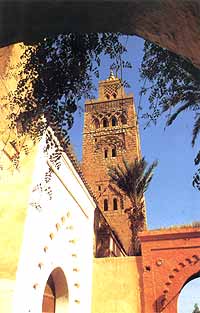
the
call
of
the
muezzin
going
out
from
the
70
metre
high
Koutoubia,
the
spiritual
beacon
of
Marrakesh.
Sunrise
over
Marrakesh.
A
multicoloured
crowd
invades
the
winding
streets
of
the
medina.
Groups
of
men
jostle
towards
the
Ben
Youssef
mosque,
nestling
against
the
Medersa,
the
vast
and
superb
Koranic
school
founded
by
the
Mérinide
sultan
Abou
el-Hassan
(1331-1349)
and
one
of
Marrakesh's
most
remarkable
monuments.
The
sun
bathes
Marrakesh
in
light.
Its
rays
show
up
the
pink
marble
of
the
fountains,
spread
across
the
tiled
courtyards,
are
reflected
and
then
bring
warmth
to
the
turquoise,
greens
and
whites
of
the
mosaic,
to
finally
be
lost
amidst
to
stucco
of
the
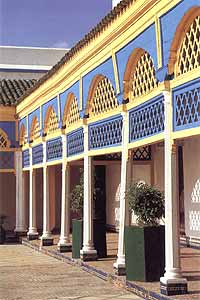
Bahia
Palace
and
the
Dar
Si
Saïd,
now
a
museum
housing
the
finest
masterpieces
of
Moroccan
art.
The
legendary
sun
of
Marrakesh
adds
a
note
of
accentuated
contrast
to
the
imperious
splendour
of
the
Saadian
tombs.
It
illuminates
the
remains
of
the
Badii
Palace
where
a
shimmering
mirage
may
reveal
the
wonder
of
these
former
glories
to
the
dazzled
visitor;
the
gold,
the
marble
and
the
onyx
which
were
traded
for
their
weight
in
sugar
by
the
most
celebrated
Saadian
ruler,
Ahmed
el
Mansour
(1578
-
1603).
The
sun
sets
over
Marrakesh.
Then,
against
a
sky
blazing
with
evening
fire
bounded
by
the
eternal
snows
of
the
Atlas
mountains,
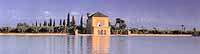
the
perfect
proportions
of
the
Ménera
pavilion
may
be
contemplated,
mirrored
in
the
quiet,
still
waters
that
stand
before
it.
Time
has
passed
you
by.
In
the
copper
souk
perhapss,
where
the
metal
is
worked
by
craftsmen
following
age-old
traditions,
their
faces
set
in
profound
concentration.
Or
perhaps
it
was
in
the
Laghzal
Souk,
home
of
the
wool
merchants.
Or
in
el
Btana
with
its
sheepskins.
Or
even
in
the
hubbub
of
the
Zarbia
souk,
where
carpets
and
caftans
are
sold
to
the
highest
bidder...
You
are
in
another
world.
Where
the
smell
of
saffron,
cumin,
black
pepper,
ginger,
verbena,
cloves
and
orange
flower
enchant
the
nostrils.
Among
sacks
of
almonds,
ground
nuts
and
chick
peas
piled
high
like
mountains,
with
baskets
of
dates,
casks
of
olives
and,
on
the
apothecaries'
shelves,
pots
of
henna,
ghassoul,
flasks
of
rose
extract,
jasmine,
mint,
khôl,
pieces
of
amber
and
musk...
You
are
in
the
souks
of
Marrakesh.
Outside
the
ochre-coloured
ramparts,
the
rhythm
is
broken,
the
colours
change.
The
sound
of
the
wind
in
the
foliage,
chirping
birds,
the
heady
odours
of
jasmine
and
honeysuckle
and
the
president
perfume
of
the
famous
Marrakesh
roses.
Here,
nature
is
a
haven
of
peace,
beauty
and
contemplation.
No
doubt
it
is
grateful
to
man
for
having
watered
it
since
1106
by
means
of
an
ingenious
system
of
collecting
and
channelling
spring
water,
13,000
hectares
of
vegetation,
180,000
palm
trees,
a
world
class
golf
course;
this
is
the
renowned
Palmeraie
(Palm
Grove)
of
Marrakesh.
Further
away,
behind
the
Royal
Palace,
stretch
the
Agdal
orchards,
the
setting
for
lavish
festivals
and
celebrations.
The
trees
weigh
themselves
down
with
exquisite
fruit
as
the
seasons
advance;
oranges,
figs,
pomegranates
and
olives...
And
near
Bab
Doukkala
stands
the
Majorelle
garden
with
its
abundance
of
giant
bamboo,
yucca,
papyrus,
palm,
cypress
and
banana
trees,
philodendrons
and
bouganvillaeas,
and
amazing
cacti
with
natural
colours
that
contrast
vividly
with
the
bright
blue
facade
of
the
villa.
The Wonders of the Atlas Mountains
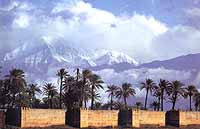
Seen
from
Marrakesh,
the
vast,
imposing
mass
of
the
snow-capped
mountains
seems
unreal
and
unbelievable.
And
yet
the
splendour,
other-worldiness
and
imposing
might
of
the
constantly
changing
Atlas
landscape
are
only
20
kilometres
away.
Just
head
out
South
East
of
Marrakesh,
through
the
friendly
Berber
villages
of
Aghmat
and
Dar
Caïd
Ouriki.
Follow
the
road
bordered
with
terraced
gardens
along
Wadi
Ourika
until
you
reach
Arhbalou.
From
there
on,
the
choice
is
simply
limitless.
Bear
right
towards
Oukaimeden
(2,600
m),
the
famous
winter
sports
resort
only
74
km
from
Marrakesh.
Or
else
admire
Setti
Fatma
and
its
hundred-year
old
walnut
trees
and
dive
into
the
invigorating
coolness
of
its
seven
waterfalls.
Or
possibly
go
on
to
Annameure,
village
of
the
Aït
Oucheg
tribe
where
you
can
hire
a
mule
and
climb
up
as
far
as
Djebel
Yagour,
centre
of
Moroccan
prehistory
which
boasts
over
2,000
cave
paintings.
To
the
South,
another
change
of
scene.
47
km
from
Marrakesh,
on
the
road
to
Taroudannt,
in
the
typically
Berber
which
is
held
every
Saturday.
Towards
Ouirgane,
the
Landscape
is
reminiscent
of
American
canyons.
Magnificent
gorges
lead
to
Imlit,
a
charming
mountain
hamlet.
This
is
the
starting
point
for
hikes
through
Toubkal
national
park:
climbing
to
the
summit
(4165
m),
North
Africa's
highest
point
or,
at
3800
m,
the
Tazaghaght
plateau,
a
stone
strewn
desert
at
such
an
altitude
that
it
looks
down
upon
the
clouds.
East
of
Marrakesh,
water,
water
everywhere!
The
Ouzoud
Falls,
where
the
water
plunges
for
more
than
100
meters.
Wadi
Mehasseur,
spanned
by
the
natural
Imi-n-Ifri
bridge,
the
"gateway
to
the
abyss"
in
Berber,
which
cascades
through
vast
rock
formations
to
end
in
the
artificial
Aït-Aadel
lake
surrounded
by
bare,
red
coloured
hills.






EGYPT - LEBANON - SYRIA