

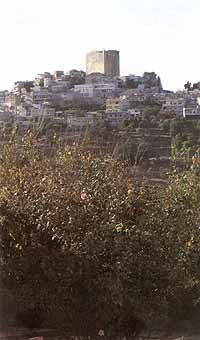
The present-day town with the tiled roofs stands on the site of the fortress that was called 'Castle le Blanc' by the Crusaders. One of its huge towers, about 38m high is still standing; this tower contains a chapel, which has never been deconsecrated: Christians still hold their services in it.
Places of archaeological in the district of Safita are:
Hosn Sleiman:
25 km from Safita; 14 km beyond Draykish, in the direction of Misyaf. 'Hosn Sleiman' is the Arabic name for the site of ancient Baetocece; it was here, in the heart of these wild mountains cut through by ravines, that the inhabitants of Aradus (the present Isle of Arwad) once built a temple dedicated to Baal and Astrate.
Arima
Today
Qalaat
al-Arayma
(15
km
southwest
of
Safita),
once
a
forward
strong-point
for
Castle
le
Blanc
and
for
the
Crac,
it
still
has
two
towers
dating
back
to
the
12th
and
13th
centuries.
Qal'at
Yahmur
(Chastel
Ronger
or
Castrum
Rubrum),
20
km
west
of
Safita
on
the
Tartus
road.
Like
Arima,
Qal'at
Yahmur
was
a
small
fortress,
and
its
15m
high
keep
is
still
impressive.
Mention
should
also
be
made
of
the
summer
resorts
north-east
of
Safita.
Mashta
al-Helu
is
the
largest
in
a
group
of
small
villages
scattered
on
the
green
hills,
where
the
weather
is
cool
even
on
the
hottest
summer
days.
The
most
attractive
among
these
white
stone
villages
is
al-Kafroon
(3
km
from
Mashta
al-Helu).
It
is
located
at
the
foot
of
a
small
hill,
completely
covered
with
oak
trees
and
surrounded
by
mountains
with
many
churches
and
mosques.
Also
worth
visiting
is
Mar
Elia,
a
cave-like
church
in
the
north
of
the
village.
There
are
several
hotels,
restaurants
and
cafes
in
the
apple
orchards
along
the
streams
that
run
through
it.
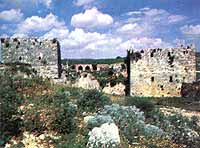
Qal'at
al-Hosn
(Crac
des
Chevaliers)
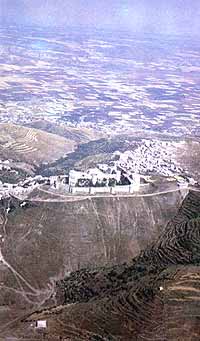
The
most
famous
medieval
citadel
in
the
world,
Qal'at
al-Hosn
is
65km
west
of
Homs
and
75
south-east
of
Tartus.
It
is
650m
above
sea-level.
It
was
built
in
order
to
control
the
so-called
'Homs
Gap',
the
gateway
to
Syria.
It
was
through
this
passage
that
Syria
communicated
with
the
Mediterranean.
In
ancient
times
the
importance
of
the
strategic
corridor
was
immense.
It
was
of
crucial
importance
to
the
Crusaders
and
other
foreign
invaders
in
their
conquest
of
the
coast.
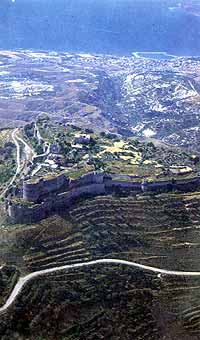
Qala'at
Salah
al-Din
Formerly
'Saone'
(and
still
known
as
Castle
Sahyoun),
it
was
recently
named
after
the
great
hero
of
Islam,
Salah
al-Din,
to
commemorate
the
capture
of
the
fortress
in
1188.
Though
the
importance
of
the
position
had
been
exploited
before
the
Crusaders,
this
castle
was
described
as
the
most
impregnable
Crusader
fortress.
It
stands
on
a
rocky
spur
whose
vertical
walls
rise
above
the
junction
of
two
fast-flowing
streams.
As
late
as
1965
it
was
impossible
to
reach
it
except
on
foot
or
on
horseback
by
a
difficult
climb,
first
downhill
and
then
up
again
after
fording
a
stream.
The
fortress
was
completely
isolated
from
the
plateau
by
a
deep
ditch
dug
right
through
the
connecting
neck
of
land.
The
ditch
was
156m
long,
18m
wide
and
18m
deep.
Its
vertical
walls
show
a
smooth,
fine
yellowish
rock
surface.
Today
there
is
a
drawbridge
and
a
road
which
provide
easy
access
to
the
foot
of
this
'eagle's
nest'.
Visitors
can
park
their
cars
at
the
bottom
of
this
ditch,
opposite
the
horses'
mangers
and
hitching
holes
carved
out
of
the
rock.
Qal'at
al-Marqab
(al-Marqab
Citadel)
This
citadel
is
only
6km
south-east
of
Banyas,
and
is
500m
above
sea-level.
It
is
enormous:
there
aren't
less
than
fourteen
square
and
round
towers
jutting
from
the
curtain
wall
that
encircles
the
hilltop
to
form
a
triangular
bastion.
Its
southern
corner,
sharper
than
the
others
and
bristling
with
defenses,
has
a
keep
rising
above
it
like
the
prow
of
a
ship.
What
makes
it
particularly
glowering
is
the
black
basalt
stone
with
which
it
was
built.
There
are
beautiful
gardens
and
orchards
surrounding
it
and
the
sea
is
not
far
away.
This
citadel
could
accommodate
1000
people,
in
addition
to
the
garrison,
along
with
provisions
to
last
them
for
five
years.
Safita
Summer
on
the
Coast
Qal'at
al-Hosn
Qal'at
Salah
al-Din
Qal'at
al-Marqab
(DAMASCUS - LATAKIA - PALMYRA - HOMS - HAMA - ZABADANI)
(BOSRA - BANYAS - TARTUS - ARWAD)

EGYPT - LEBANON - JORDAN