

Unlike most Roman cities, Thuburbo Majus lacks the straight streets, the rectangular outlay. What remains of the city points in a direction of an organically grown settlement. Streets were often narrow, winding, and houses had few 90 degree angles. Even the two baths in this minor town, had irregular shapes. The site today is no more than 250 times 300 metres, and much of the best leftovers have been moved to the Bardo museum in Tunis.
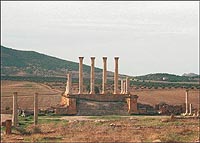
Thuburbo
Majus
is
still
very
much
worth
the
visit,
as
many
columns
still
stand,
and
one
area
has
walls
two
metres
tall,
Openings
indicate
where
doors
have
been,
and
inside
one
of
the
houses,
a
mosaic
floor
is
in
excellent
condition,
only
broken
by
three
well-kept
columns
in
strong
reddish
colours.
 The
city
of
Colonia
Julia
Aurelia
Commoda
was
established
in
27
BC,
as
a
veterans'
colony,
and
served
as
a
regional
administrative
centre.
Its
heydays
lasted
for
about
200
years,
and
when
it
was
rebuilt
in
the
4th
century
it
was
under
the
name
of
Thuburbo
Majus.
Today
it
is
really
only
the
layout
that
is
left,
but
four
columns
of
the
Capitol
has
been
restored.
Thuburbo
Majus
is
counted
among
the
secondary
Roman
sites
of
North
Africa.
The
city
of
Colonia
Julia
Aurelia
Commoda
was
established
in
27
BC,
as
a
veterans'
colony,
and
served
as
a
regional
administrative
centre.
Its
heydays
lasted
for
about
200
years,
and
when
it
was
rebuilt
in
the
4th
century
it
was
under
the
name
of
Thuburbo
Majus.
Today
it
is
really
only
the
layout
that
is
left,
but
four
columns
of
the
Capitol
has
been
restored.
Thuburbo
Majus
is
counted
among
the
secondary
Roman
sites
of
North
Africa.

EGYPT - SYRIA - JORDAN