

Tozeur is very much a city relying on tourism, but everything is done in a tasteful manner. Early developers understood that it was the traditions and culture that represented the possibilities for the future. While agriculture remains an important income, tourism employs a large part of the 20,000 inhabitants, though the city appears to hold more people. But it is not only the lifestyle and the specific architecture of Tozeur, that bring tourists
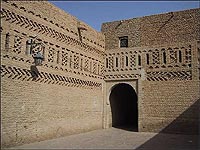
out here. The city is well situated at the fringe of the seasonal large lake Chott el Jerid.
The
250,000
date
palms,
and
all
the
vegetation
in
between,
get
the
water
from
200
springs.
The
entire
oasis
is
about
11
sq
km,
with
Tozeur
as
the
large
centre,
but
there
are
small
settlements
scattered
around
the
area.
Houses
along
the
main
streets
are
covered
by
rectangular
yellow
bricks,
that
are
making
patterns
when
they
are
arranged
in
two
levels.
The
result
is
one
of
the
most
distinct
and
beautiful
architectures
of
Tunisia.
As
all
houses
now
are
turning
to
this
style
(you
can
still
see
some
houses
where
the
bricks
are
added
to
walls
that
are
far
from
any
need
of
restauration),
the
stunning
effect
now
found
in
Ave
Bourgiba
will
dominate
the
whole
city.
Around
the
city,
nature
is
far
from
flat,
and
tiny
valleys
and
riverbeds
are
found
all
over.
Between
the
palms
that
are
penetrating
the
city
from
all
sides,
a
complicated
irrigation
system
is
found,
together
with
plants
and
trees,
that
gives
plums,
grapes
and
strawberries.
Tozeur
has
also
got
one
of
the
best
museums
of
Tunisia,
which
at
a
high
entrance
fee,
has
exhibitions
depicting
life
among
both
ordinary
and
the
rich
in
times
no
bygone.
Instead
of
the
normal
bus
driver
uniforms,
the
personnel
here
wears
traditional
costume,
and
whenever
you
find
a
corner
without
other
visitors,
you
can
imagine
what
Tunisia
a
hundred
years
ago
was
like.
As
for
small
details,
this
almost
metropolitan
city
has
surprisingly
many
bikecycles,-
very
rare
in
Tunisia,
and
quite
a
number
of
women
in
black
veils
covering
everything.

EGYPT - SYRIA - JORDAN