

Twenty
kilometers
south
of
Sidon
you
reach
the
town
of
Adlun,
the
southernmost
city
of
Sidonian
territory.
The
modern
place
name
Adlun
derives
from
the
Latin
toponym,
Mutatio
ad
Nonum,
mentioned
in
the
Bordeaux
Itinerary
and
said
to
be
located
18
kilometers
north
of
Tyre.
Like
Sarafand,
the
ancient
settlement
lies
under
the
ruins
of
Tell
Ras
Abu
Zayd
on
the
seashore,
while
the
modern
village
is
built
on
the
neighboring
hills.
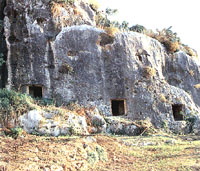
The ancient name of Adlun remains a debated question. It may be the Marubbu of the annals of Esarhaddon and this name survives in the modern toponym of near-by al Maarib. In the classical period, the site was called Ornithonpolis.
The
Prehistoric
Caves
of
Adlun.
Adlun
is
one
of
the
most
famous
prehistoric
sites
of
Lebanon.
A
rock
shelter,
a
deposit,
as
well
as
two
caves
were
identified
in
Adlun
as
early
as
the
19th
century.
The
excavation
of
one
of
the
caves,
the
so-called
Mgharet
al
Bzez,
yielded
remains
of
human
occupation
from
the
Palaeolithic
down
to
the
Neolithic
period.
The
cave
entrance
is
now
closed
with
an
iron
gate
to
protect
it
and
is
not
open
to
the
public.
A
second
cave
yielded
remains
of
the
Chalcolithic
period.
On
the
terraces
overlooking
the
caves
and
the
modern
village,
a
Neolithic
and
Chalcolithic
settlement
was
found.
The
Necropolis
of
Adlun
All
western
travellers
have
mentioned
the
large
number
of
rock-cut
tombs
on
the
hills
opposite
the
seashore.
It
is
unfortunate
that
these
cemeteries
have
never
been
properly
excavated
and
not
even
systematically
surveyed.
Most
of
them
were
robbed
in
antiquity.
The
tombs
date
to
the
first
millennium
B.C.,
from
the
Iron
Age
to
the
late
Roman-Byzantine
period.
The
oldest
tombs
have
a
shaft
while
the
later
ones
are
simple
rock
cavities
and
share
the
same
plan:
an
entrance,
a
door
leading
to
a
square
funerary
chamber
with
loculi
on
three
of
its
walls.
(BEIRUT - BYBLOS - JEITA GROTTO - TRIPOLI - SIDON - ZAHLÉ)
(AANJAR - THE CEDARS - TYRE - BAALBECK)

EGYPT - SYRIA - JORDAN