

A unique Phoenician Site in Lebanon
The Temple of Eshmoun, less than an hour from Beirut, is situated one kilometer from Sidon in a lush valley of citrus groves in the Awwali River. The site is known locally as "Bustan esh Sheikh." Whether you visit in spring when the air is fragrant with blossoms, or early winter when the fruit is ripe, Eshmoun is special.
This
Phoenician
temple
complex,
dedicated
to
the
healing
god
Eshmoun,
is
the
only
Phoenician
site
in
Lebanon
that
has
retained
more
than
its
foundation
stones.
Building
was
begun
at
the
end
of
the
17th
century
B.C.
and
later
additions
were
made
in
the
following
centuries.
Thus,
many
elements
near
the
original
temple
site
were
completed
long
after
the
Phoenician
era,
including
the
Roman
period
colonnade,
mosaics,
a
nymphaeun,
and
the
foundations
of
a
Byzantine
church.
All
of
these
buildings
testify
to
the
site's
lasting
importance.
Eshmoun
can
be
included
in
a
visit
to
Sidon,
or
made
an
excursion
of
its
own.
Visitors
with
a
sense
of
curiosity
will
find
that
several
hours
are
easily
filled
exploring
this
ancient
Phoenician
spa.
The
History
of
Eshmoun
Legend
has
it
that
Eshmoun
was
a
young
man
of
Beirut
who
loved
to
hunt.
The
goddess
Astarte
fell
in
love
with
him,
but
to
escape
her
advances
he
mutilated
himself
and
died.
Not
to
be
outdone,
Astrate
brought
him
back
to
life
in
the
form
of
a
god.
It
is
also
said
that
the
village
of
Qabr
Shmoun,
near
Beirut,
still
preserves
the
memory
of
the
young
god's
tomb.
Known
primarily
as
a
god
of
healing,
Eshmoun's
death
and
resurrection
also
gave
him
the
role
of
a
fertility
god
who
dies
and
is
reborn
annually.
As
the
god
of
healing,
Eshmoun
was
identified
with
Asklepios,
the
Greek
god
of
medical
art.
It
is
from
belief
in
the
healing
power
of
Eshmoun-
Asklepios
and
the
snake
that
we
get
the
sign
of
the
medical
profession
that
is
now
used
worldwide.
Our
modern
caduceus,
a
staff
intertwined
with
two
serpents,
is
derived
from
these
symbols.
The
caduceus
can
be
seen
in
a
gold
plaque
of
Eshmoun
and
the
goddess
Hygeia
(Health)
which
was
found
near
the
temple.
It
shows
Eshmoun
holding
in
his
right
hand
a
staff
around
which
a
serpent
in
entwined.
There
is
also
an
early
3rd
century
A.D.
Beirut
coin
depicting
Eshmoun
standing
between
two
serpents.
Each
Phoenician
city
state
had
its
own
gods,
and
Eshmoun
was
one
of
the
favorites
of
Sidon.
The
site
of
his
temple
must
have
been
chosen
because
of
the
nearby
water
source
which
was
used
in
the
healing
rituals.
It
was
the
custom
to
offer
statues
to
the
god
that
bore
the
names
of
those
who
came
for
healing.
The
fact
that
most
of
these
votive
pieces
depict
children
suggests
that
Eshmoun
may
have
been
regarded
as
the
pediatrician
of
the
times.
During
the
Persian
era,
between
the
6th
and
4th
centuries
B.C.
Sidon
was
the
first
Phoenicia
city
to
be
noted
for
the
opulence
of
its
kings,
the
advanced
culture
of
its
intelligentsia
and
the
excellent
reputation
of
its
industry.
The
Persian
kings
held
the
kings
of
Sidon
in
great
regard
and
granted
them
many
rewards,
especially
for
the
Sidonian
fleet's
active
participation
on
their
side
during
their
wars
against
Egyptians
and
Greeks.
It
was
a
that
time
that
Eshmounazar
II,
the
son
of
Tabnit
I,
acceded
to
the
throne.
Inscriptions
found
on
the
sarcophagus
of
Eshmounazar
(discovered
in
1858
and
now
in
the
Louvre
Museum)
relate
that
he
and
his
mother
Amashtarte
(servant
of
Astarte)
built
temples
to
the
gods
of
Sidon.
One
of
these
was
the
temple
of
the
Holy
God
"Eshmoun
at
the
source
of
Yidlal
near
the
cistern."
The
temple
of
Eshmoun,
built
by
Eshmounazar
II
and
rediscovered
in
this
century
during
the
excavations
at
Boustan
esh-Sheikh,
was
destroyed
around
the
middle
of
the
fourth
century
B.C.
Although
the
temple
was
never
rebuilt,
some
small
buildings,
chapels
and
pools
were
restored.
This
allowed
visitors,
pagan
as
well
as
Christian,
to
attend
the
sanctuary.
The
site
remained
popular
until
the
end
of
the
third
century
A.D.,
even
though
it
was
largely
in
ruins
and
littered
with
debris.
The Excavations
For centuries before its excavation, the site of the Temple of Eshmoun was used as a quarry. Emir Fakhreddine, for example, used its massive blocks to build a bridge over the Awwali River in the 17th century. Today only the foundations of this bridge remain.

In
1900,
an
Ottoman
expedition
found
Phoenician
inscriptions
in
the
area
of
the
yet
undiscovered
temple.
Twenty
years
later
successful
soundings
were
made
on
the
site
and
in
1925-26
excavations
near
the
river
uncovered
the
Roman
mosaic
floor
and
several
marble
statuettes
of
children
dating
to
the
Hellenistic
period
(330-64
B.C.).
Another
inscription
in
Phoenician
letters
bearing
the
name
Eshmoun
was
found
near
the
river
a
short
time
later.
A
few
kilometers
from
the
site
inscriptions
bearing
the
name
of
Bodashtart
were
found,
probably
incised
on
the
occasion
on
the
completion
of
an
important
canal
system.
Although
the
land
around
the
site
was
purchased
in
the
mid-1940's,
serious
excavation
work
did
not
begin
until
1963.
Visiting
the
Site
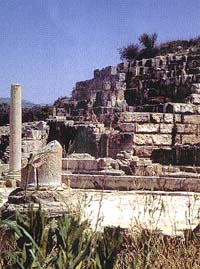
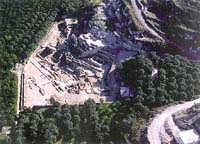
The most imposing ruin at Eshmoun is the temple, or temple complex (numbers 1-9 on the plan). An overall view of Eshmoun can be had by climbing the mosaic-covered Roman stairway.
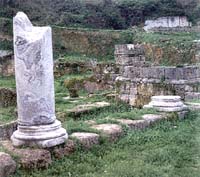
The approach to the temple site is along a Roman colonnaded road. On the right is a massive capital with four carvings of bulls' head which go back to the Persian period. They were placed here at a later date in a shrine set up in the courtyard of the temple.
The oldest section is a pyramid shaped structure with a short flight of stairs on its summit and a wall to its right dating from the 6th century B.C., when Phoenician city states were under the political and cultural influence of Babylon.
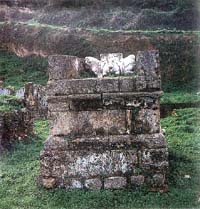
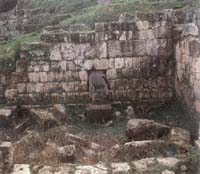
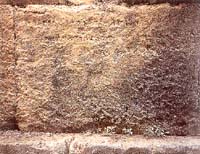
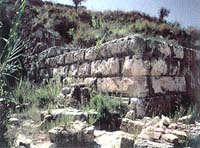
The second and largest podium was built by the Sidonian King Eshmounazar in the 5th century B.C. and probably enlarged later by a King Bodashtart whose inscriptions can still be seen on one of the inner slabs of the massive retaining walls of the temple.
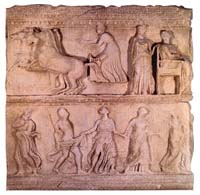
The
site's
healing
waters
were
channeled
through
a
canal
system
to
the
sacred
basins.
Another
temple
was
added
in
the
3rd
century
B.C.
You
can
still
see
part
of
the
original
frieze
representing
worshippers,
hunting
scenes,
and
children's
games.
Near
the
far
northwest
angle
of
the
temple
is
a
sanctuary
of
Venus/Astarte,
also
from
the
Hellenistic
period.
Inside
this
small
area
measuring
11x10
meters,
is
a
throne
flanked
by
two
sphinxes
which
is
known
as
the
"Throne
of
Astarte."
The
throne
stands
on
a
single
block
of
stone
with
a
cornice
sculptured
in
the
Egyptian
style.
A
frieze,
unfortunately
very
mutilated,
depicts
a
hunting
scene.
A
later
addition
to
the
temple
is
a
small
mosaic
room
guarded
by
a
now
headless
sphinx.
An
inscription
dates
this
section
to
335
A.D.
To
the
left
of
the
pool
stands
a
22
meter-long
wall
with
reliefs
of
drunken
revelry
and
a
man
attempting
to
seize
a
large
plumed
cock.
It
was
apparently
common
practice
among
the
Greeks
to
sacrifice
cocks
to
Asklepios
(Eshmoun).
During
the
Roman
and
early
Christian
eras
(64
B.C.
to
330
A.D.)
the
site
of
the
Temple
of
Eshmoun
and
its
miraculous
waters
continued
to
serve
as
a
place
of
pilgrimage.
Within
the
Phoenician
temple
site
the
Romans
added
the
processional
stairway,
basins
for
ablutions
and
a
nymphaeum
with
pictorial
mosaics,
largely
still
intact.
Worn
statuettes
of
three
nymphs
stand
in
the
niches
of
the
fountain.
On
the
left
side
of
the
Roman
road,
opposite
the
temple
complex,
is
a
courtyard
with
the
remains
of
mosaics
depicting
the
Four
Seasons.
To
the
left
of
the
Roman
courtyard
are
the
foundations
of
a
Byzantine
period
basilica,
the
last
major
period
represented
at
Eshmoun.
The
Site
Today
There are no concessions or facilities at the site. However, the visit is just minutes from Sidon where the government Rest House, located near the Sea Castle, serves meals 12:00 to 4:00 pm and 7:00 to 12:00 pm.
(BEIRUT - BYBLOS - JEITA GROTTO - TRIPOLI - SIDON - ZAHLÉ)
(AANJAR - THE CEDARS - TYRE - BAALBECK)

EGYPT - SYRIA - JORDAN