

"Holy
Valley"
of
History
(6
Km
from
Bsharre)
The Qadisha Valley near Bsharre marks the start of a deep geological fault whose extending valleys reach out of sight to the sea. The word "Qadisha" comes from a Semitic rot meaning "holy" and Wadi Qadisha is the "Holy Valley".
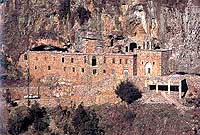
The gorge is best explored on foot. A narrow vehicular road descends to the bottom, but it is more fun to take one of the paths from the villages of Tourza, Blawza, Hadchit, Hasroun and Diman. The Qadisha River, whose source is the Qadisha Grotto, runs through the valley, continuing down to Tripoli where it becomes the Abu Ali River.
On the old road between the Cedars and Bsharre is the Qadisha is the Qadisha Grotto, where water thunders down from snow-fed springs. A sign marks the spot where you take a footpath from the roadside to the cave, a walk of about ten minutes. The cave is lighted to show its limestone formations, but the rushing water and cool temperatures are the main attractions here. Below the cave is a powerful waterfall, especially full in spring months. Closed during the winter, in summer this is the site of an outdoor restaurant and cafe.
(BEIRUT - BYBLOS - JEITA GROTTO - TRIPOLI - SIDON - ZAHLÉ)
(AANJAR - THE CEDARS - TYRE - BAALBECK)

EGYPT - SYRIA - JORDAN