

Ras
el
Metn
is
approached
from
Mansourieh
along
a
road
that
winds
through
an
unspoiled
landscape
of
pine-clad
hills.
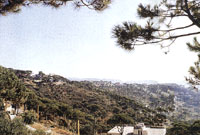
The
village
itself,
visible
on
a
high
mountain
ridge,
holds
the
promise
of
spectacular
views.
From
its
heights
(between
800
and
1,000
meters)
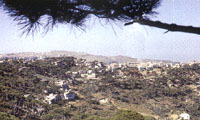
one
can
also
look
out
across
the
valley
to
the
towns
of
Dhour
Chweir,
Baabdat,
Broumana
and
Beit
Mery.
This
villages
which
have
about
10,000
people,
is
notable
for
its
sense
of
civic
pride.
It
is
also
the
birthplace
of
one
of
Lebanon's
most
famous
modern
personalities,
the
writer
Anis
Freiha.
The
beautiful
umbrella
pines
that
surround
the
village
are
a
source
of
valuable
pine
nuts,
while
olives,
grapes,
figs,
apricots
and
other
fruits
are
cultivated
here
as
well.
A
look
around
Ras
El
Metn
will
reveal
a
number
of
interesting
sights.
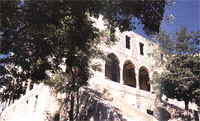
On
a
high
hill
stands
a
large
serail,
or
government
house,
built
by
the
Lamaayeen
princes
in
1775.
The
huge
building
later
served
as
a
high
school.
Although
damaged
in
Lebanon's
recent
war,
one
can
still
appreciate
the
serail's
elegant
courtyard
and
bell
tower.
Restoration
work
is
planned
for
the
near
future.
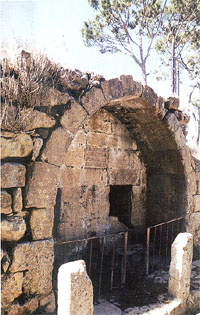
Also
scheduled
for
restoration
is
the
spring
known
as
Nabaa
Ein
el
Marj,
found
in
the
lower
part
of
the
village.
Remarkable
for
its
arched
facade
built
in
1472,
the
plaque
recording
its
construction
is
still
in
place.
Much
older,
are
the
ancient
tombs
carved
into
the
rocky
cliffs
and
headlands
of
Ras
El
Metn,
while
just
below
the
village
the
refuge
of
a
holy
woman,
Sitt
Sarah
can
be
found
in
a
rock-
scattered
field.
According
to
the
legend,
a
rock
miraculously
opened
into
a
cave
to
shelter
Sitt
Sarah
as
she
fled
from
danger.
Finally
carved
from
living
stone,
the
site
is
an
ancient
tomb
chamber.
Hikers
should
also
ask
about
the
Grotto
of
Hiskan,
which
is
about
a
two
hours
walk
from
the
village.
(BYBLOS - JEITA GROTTO - TRIPOLI - SIDON - ZAHLÉ - BAALBECK)
(THE CEDARS - TYRE - BEITEDDINE - AANJAR)

EGYPT - SYRIA - JORDAN