

Salihiye
This ancient site, was originally named Doura, which in Old Semitic meant fortress. When the Seleucids took over, one of Seleucus I's generals founded a colony here and added the name Europos to it. Europos was the name of the town that Seleucus was born in, back in Macedonia.
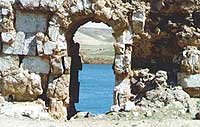
In 165 AD Rome took over the city and strengthened its fortification and defensive structures against the threat of the Sassanians, a more powerful Persian dynasty. In 256 AD the Sassanians managed to break through the Roman barracks and they destroyed this city forever.
It was discovered in the 1920's by some British soldiers who used the wall for protection against a small fight with some bedouins, and Doura Europos has since then changed the perspective on Christian and Judaic art.
Doura Europos is a typical Hellenistic city plan, a rectangular grid. There is a Decumanus running from west to east that starts at the Palmyra Gate. Found in Doura Europos was the first known place of Christian worship in Syria, a chapel that had been changed from a normal residence in 240 AD. Its walls were covered with many Biblical scenes, some of its pieces are at Yale University. Another important place of worship was the Synagogue, which was probably built at the end of the 2nd century AD. Its frescoes, depicting the Exodus, can be seen at the Damascus National Museum.
The most remarkable feature of Doura Europos is under a tower, where Sassanians and Romans drove mines and met underground in a battle. Many of the soldiers were found wearing their armour and having evidence of the date on coins, which they were carrying.
Several temples dedicated to a variety of Deities were found in Doura Europos, including three temples to Zeus, one to Jupiter, one to the Palmyrean Gods, one to Adonis, another to Artemis, and a few others.
(ALEPPO - DAMASCUS - LATAKIA - PALMYRA - HOMS - HAMA)
(BOSRA - BANYAS - TARTUS - ZABADANI)

EGYPT - LEBANON - JORDAN